Trends in the use of full-time imprisonment 2006–2007
Introduction
This Sentencing Trends & Issues tackles the continuing issue discussed in Monograph 29: “how do sentencing patterns in New South Wales compare with other jurisdictions?”1 As that publication illustrated, the answer is relevant to the public debate on whether sentencing is too harsh or too lenient.2 Indeed either assertion can only be truly tested by reference to other comparable jurisdictions. Full-time imprisonment is used as a comparative indicator because it is a sanction of last resort in common law jurisdictions and therefore a reliable measure of punitiveness.3
This Sentencing Trends & Issues takes advantage of the ongoing release of new sentencing information in Australia and overseas.4 Court outcomes including convictions and the use of full-time imprisonment are updated annually by government agencies.5 National reporting bodies such as the Australian Bureau of Statistics and the Productivity Commission provide annual releases of corrective services data. Research agencies report national and international sentencing information.6
As the Chief Justice of Australia the Honourable Murray Gleeson observed extra-judicially in 2004:
“The more information people are given about what sentencing judges are doing, and why they are doing it, the less likely they are to believe that there is a gulf between their expectations of the criminal justice system and the reality. The more accurate and reliable the information that the public get about what judges do, about the detail of the cases they confront, and about their reasons for decisions, the less likely they are to think that judges do not understand or share their concerns.”7
As part of the public supply of information, Chief Justice Gleeson identified the need for useful sentencing comparisons:
“There is one topic on which the Australian public are given practically no information at all, and that is the way in which sentences in Australia compare with sentences imposed in similar places overseas.”8
The ongoing reporting of sentencing results in New South Wales and other jurisdictions is a step towards filling this void.
Key findings
The latest sentencing data confirms many of the conclusions of the earlier study. The use of full-time imprisonment in Australia remains at historically high levels. Comparing imprisonment rates per 100,000, New South Wales remains higher than the Australian average as well as some overseas jurisdictions. New South Wales continues to report the highest imprisonment rates in Australia for a number of specific offences.
Imprisonment rates per 100,000 adult population
- New South Wales reported the fourth highest adult imprisonment rate in Australia (176) per 100,000 adult population.
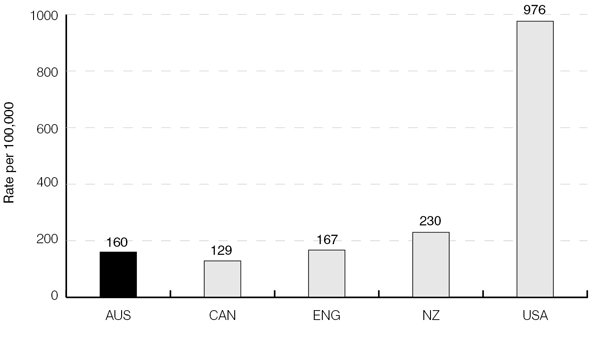
- The New South Wales adult imprisonment rate was higher than the Australian average (160), as well as England (167) and Canada (129).
Imprisonment rates per 100,000 total population
- New South Wales reported the third highest imprisonment rate in Australia per head of total population (141).
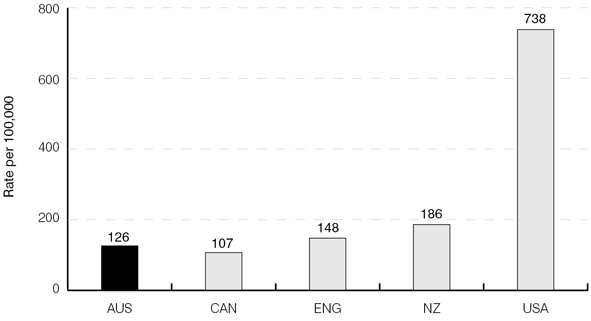
- This was higher than the Australian average (126) and Canada (107), but below England (148).
Full-time imprisonment for specific offences
- New South Wales again reported the highest imprisonment rate in Australia as a proportion of those convicted for sexual assault (93%), robbery (82%) and more serious robbery offences (84%).
- The imprisonment rate for break and enter/burglary offences (77%) remained higher than all Australian and international jurisdictions.
Corrective services in Australia
- New South Wales had the third highest cost per prisoner per day ($256.80), after the Australian Capital Territory ($291.30) and Victoria ($259.20).
- Prison capacity in use in New South Wales (103.6%) was the second highest after South Australia (111.9%).
Prison population and length of sentences in Australia
- The Indigenous imprisonment rate in Australia was 13 times higher than the non-Indigenous rate. In New South Wales, the Indigenous rate was 12 times higher.
- The Australian imprisonment rate for juveniles has fallen 29% in the last ten years. New South Wales recorded the largest single decrease of 49%.
- Within Australia, 18% of prisoners are serving total sentences of less than 12 months; 57% of prisoners have previously served a sentence of adult imprisonment.
Imprisonment rates per 100,000
As stated in Monograph 29, imprisonment rates per 100,000 provide a broad indicator of punitiveness but should be treated with caution and read alongside other measures.
Using the most reliable and official data available at the time, the earlier report included imprisonment rates per 100,000 based on adult population in Australia and Canada, and total population including juveniles for New Zealand, England and the United States. To provide further specificity on comparative imprisonment rates per 100,000, this study reports separate rates for each jurisdiction for both adult and total population.
This approach was adopted because recent unreported data from the New Zealand Ministry of Justice suggests that restricting results for New Zealand to adult population only would significantly increase the imprisonment rate for that jurisdiction. The rates for England and the United States would also be higher.
Adult population rates
As Figure 1 illustrates, within Australia, New South Wales continues to report the fourth highest imprisonment rate per 100,000 head of adult population (176), after the Northern Territory (552), Western Australia (228) and Queensland (180). The New South Wales rate remains nearly double the Victorian rate (98).
Figure 2 shows that the New South Wales adult imprisonment rate of 176 is higher than the Australian average (160), as well as the adult rates for England (167) and Canada (129).9 The United States (976) and New Zealand (230) were higher.
Figure 1: Australian imprisonment rates per 100,000 adult population, 200610
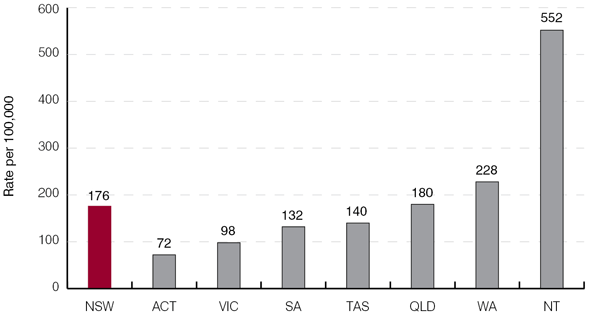
Figure 2: International imprisonment rates per 100,000 adult population11
Total population rates
Figure 3 presents Australian imprisonment rates per 100,000 head of total population, which includes persons aged less than 18 years old. In 2005, New South Wales (including the Australian Capital Territory) reported the third highest imprisonment rate (141), below the Northern Territory (404) and Western Australia (173), but above Queensland (135).
Compared with national and international imprisonment rates per 100,000 head of total population (Figure 4 below), New South Wales (141) was higher than the Australian average (126) and Canada (107), and below England (148). The United States (738) and New Zealand were also higher (186).
Figure 3: Australian imprisonment rates per 100,000 total population, 200512
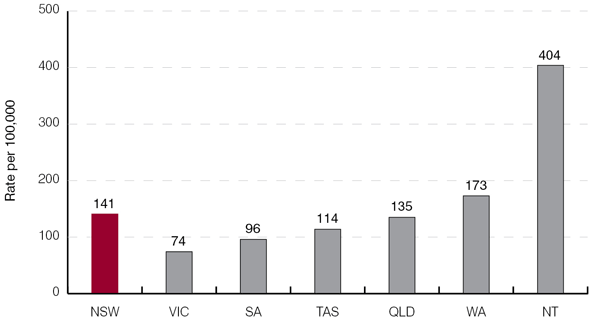
Figure 4: International imprisonment rates per 100,000 total population13
Full-time imprisonment for specific offences
Following the method employed in Monograph 29, this study reports new 2005–2006 data on the proportion of offenders receiving full-time imprisonment in four specific offence categories:
- Sexual assault
- Dangerous driving causing death
- Robbery
- Break and enter/burglary
As in the earlier study, results are compared across eight similar common law jurisdictions. The particular statutory offences encompassed in each category are unchanged from the earlier study.14 The sources of the sentencing results — the middle tier of the adult court system in each jurisdiction — are likewise unchanged.15
Most jurisdictions have reported new sentencing data since the earlier comparison. The updated time periods for sentencing results are set out below, by jurisdiction and offence category.
New South Wales
- All offence categories: 3/4/2000–31/12/200616
Victoria
- Sexual assault: 1/7/2001–30/6/2006
- Dangerous driving causing death: 1/7/2001–30/6/2006
- Robbery and more serious robbery: 1/7/2000–30/6/2005
- Break and enter/burglary: 1/7/2000–30/6/2005
Queensland
- All offence categories: 1/7/1999–31/12/2006
South Australia
- Sexual assault: 1/1/2000–31/12/2005
- Dangerous driving causing death: 1/1/2000–31/12/2005
- Robbery and more serious robbery: 1/1/2000–31/12/2005
- Break and enter/burglary: 1/1/2001–31/12/2005
Western Australia
- Sexual assault: 1/1/2004–31/12/2004
- Dangerous driving causing death: 1/1/2004–31/12/2005
- Robbery and more serious robbery: 1/1/2004–31/12/2004
- Break and enter/burglary: 1/1/2004–31/12/2004
New Zealand
- All offence categories: 1/1/2000–31/12/2005
England
- All offence categories: 1/1/2002–31/12/2005
United States
- All offence categories: 1/1/2002–31/12/200217
Sexual assault
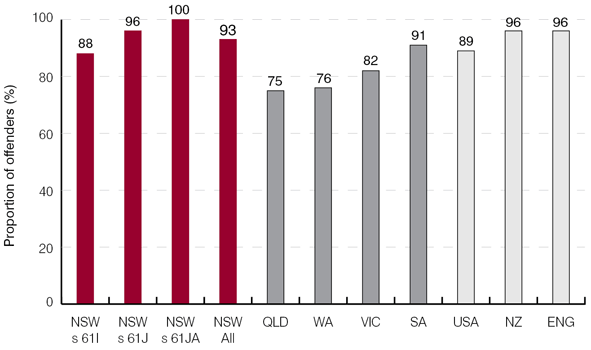
New and expanded data in Figure 5 confirms that New South Wales still has the highest proportion of sexual assault offenders sentenced to full-time imprisonment among all Australian jurisdictions.
The overall imprisonment rate in New South Wales (93%) was slightly higher than South Australia (91%). Internationally, it was lower than New Zealand and England (both 96%).
It should be noted that the expanded data for New South Wales includes persons who committed the offence prior to 1 February 2003. From that date, a more punitive standard non-parole period regime applies. See [7-900] in the Commission’s Sentencing Bench Book at www.judcom.nsw.gov.au for further details.
Since the introduction of standard non-parole periods in New South Wales, there has been an upward trend in the use of imprisonment for the three sexual assault offences selected, which shows no sign of abating. Comparing offences committed before and after 1 February 2003 in relation to s 61I offences, the imprisonment rate rises to 91% from 86%. For s 61J offences, the rate rises to 100% from 96%. The imprisonment rate for s 61JA offences remains at 100%. The overall imprisonment rate under the current regime for all sexual assaults is also higher at 95% compared with 92%.18
Figure 5: Proportion of offenders sentenced to full-time imprisonment for sexual assault offences19
Note:
Section 61I: Sexual assault
Section 61J: Aggravated sexual assault
Section 61JA: Aggravated sexual assault in company
Dangerous driving causing death
Because of varying offence categories in each jurisdiction, it is difficult to report precise comparisons for dangerous driving causing death. As noted in Monograph 29, some jurisdictions do not make a statutory distinction between whether a person is seriously injured or killed. Not all jurisdictions have a separate form of aggravated dangerous driving. In an effort to present the most similar jurisdictions, two separate results are discussed below.
Figure 6 shows results for those jurisdictions which report imprisonment rates for all offences involving dangerous driving causing death. Within Australia, the total imprisonment rate in New South Wales is the same as in South Australia (63%), and higher than Western Australia (38%). Compared internationally, New South Wales is below England (92%).20
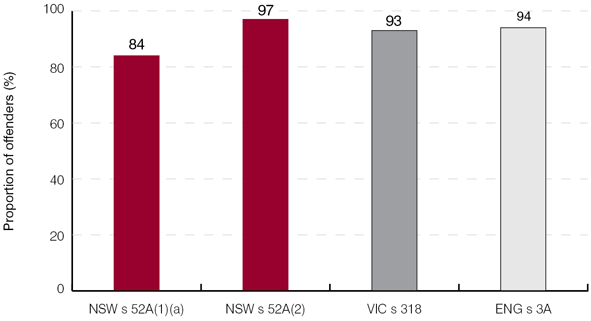
Some jurisdictions also report imprisonment rates for more serious forms of dangerous driving causing death, such as offences involving alcohol. In New South Wales, offences committed while under the influence of intoxicating liquor or drugs fall within s 52A(1)(a) Crimes Act 1900. Offences involving a blood alcohol level of 0.15 or more, or other aggravating circumstances, fall within s 52A(2).21
England also reports results for the more serious offence of careless driving causing death under the influence of drink or drugs, under s 3A Road Traffic Act 1988. Victoria reports the more serious offence of culpable driving causing death under s 318 Crimes Act 1958.
Figure 7 illustrates the generally high imprisonment rates across jurisdictions for these more serious driving offences. In New South Wales, where the circumstance of the offence involves alcohol under s 52A(1)(a) or one of the aggravating features under s 52A(2), offenders are almost always imprisoned. For an offence committed under the influence of alcohol or drugs, 84% of offenders were imprisoned. For aggravated offences, the imprisonment rate was 97%.
Figure 6: Proportion of offenders sentenced to full-time imprisonment for dangerous driving causing death22
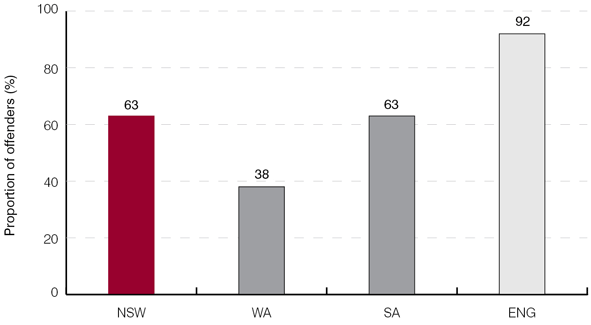
Figure 7: Proportion of offenders sentenced to full-time imprisonment for more serious driving offences causing death23
Note:
Section 52A(1)(a): Under the influence of intoxicating liquor or drug
Section 52A(2): Aggravated dangerous driving
Section 318: Culpable driving
Section 3A: Under the influence of drink or drugs
Robbery
As Figure 8 shows, New South Wales continues to report the highest imprisonment rate among Australian jurisdictions for robbery offences (82%).24 Internationally, the New South Wales rate is equal to New Zealand, but slightly below England (85%) and the United States (86%).
Similarly, when more serious forms of robbery are isolated (Figure 9 below), New South Wales again reported the highest imprisonment rate in Australia (84%).
Figure 8: Proportion of offenders sentenced to full-time imprisonment for robbery offences25
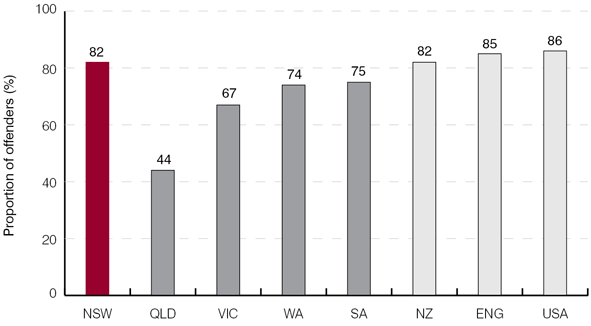
Figure 9: Proportion of offenders sentenced to full-time imprisonment for more serious forms of robbery only26
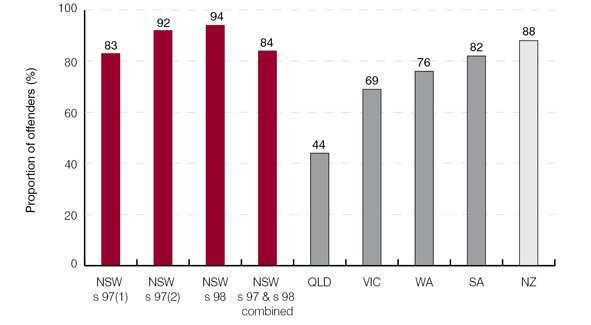
Forms of more serious robbery in NSW:
Section 97(1): Robbery armed or in company
Section 97(2): Robbery armed or in company, with a dangerous weapon
Section 98: Robbery armed or in company, with wounding
Break and enter or burglary
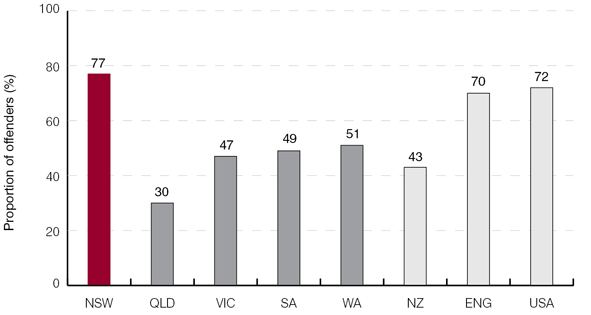
New South Wales retains the highest imprisonment rate for break and enter/burglary offences (77%), across Australian and international jurisdictions (Figure 10 below).27
Figure 10: Proportion of offenders sentenced to full-time imprisonment for break and enter/burglary28
Corrective Services in Australia
Expenditure
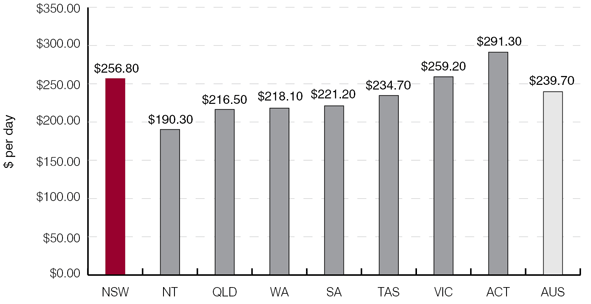
The daily cost of incarceration per prisoner is regarded by the Productivity Commission as one indicator of the efficiency of the prison system and its use of resources.29 As Figure 11 illustrates below, in 2005–2006 New South Wales had the third highest cost per prisoner per day ($256.80) after the Australian Capital Territory ($291.30) and Victoria ($259.20).
Figure 11: Expenditure per prisoner per day ($), 2005–200632
Capacity
Another indicator of the management of imprisonment is the use of prison capacity.30 According to the Productivity Commission, optimum use of capacity is between 85% and 95%. In England, appellate courts have repeatedly emphasised that overcrowding is a reason to avoid sending a non-violent offender to prison.31
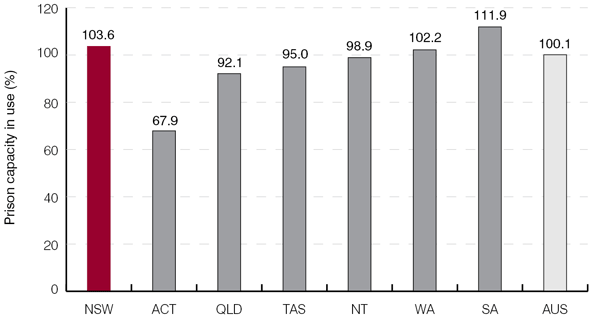
In Australia, the Productivity Commission has reported that in 2005–2006 the prison system in New South Wales was operating beyond optimal capacity. It had the second highest design capacity in use (103.6%), after South Australia (111.9%). Western Australia (102.2%) had a similarly high rate (Figure 12 below).
Figure 12: Prison capacity in use in Australian states and territories, 2005–200633
Prison population in Australia
Indigenous population
The high rate of Indigenous incarceration is a matter of ongoing public and political concern. The Royal Commission into Aboriginal Deaths in Custody found in 1991 that the imprisonment rate for Indigenous Australians was far higher than the rate for non-Indigenous Australians.34 In 2006, the national imprisonment rate for Indigenous Australians remained 13 times higher. This large discrepancy was reflected in every Australian State and Territory, as Figure 13 and Table 1 illustrate.
Figure 13: Indigenous and non-Indigenous imprisonment rates per 100,000 adult population, 200635
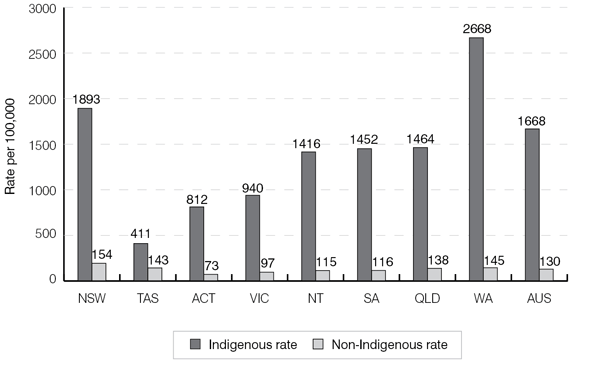
Table 1: Indigenous and non-Indigenous imprisonment rates per 100,000 population
NSW |
VIC |
QLD |
SA |
WA |
TAS |
NT |
ACT |
AUS |
|
|---|---|---|---|---|---|---|---|---|---|
| Indigenous | 1893 |
940 |
1464 |
1452 |
2668 |
411 |
1416 |
812 |
1668 |
| Non-Indigenous | 154 |
97 |
138 |
116 |
145 |
143 |
115 |
73 |
130 |
| Over-representation rate | 12 times |
10 times |
11 times |
13 times |
18 times |
3 times |
12 times |
11 times |
13 times |
While Indigenous Australians comprised just 1.6% of the adult population in New South Wales in 2006, they accounted for 19.9% of the State’s prison population.36
Ethnicity
Among all prisoners in New South Wales, 74% were Australian born, with 22% born overseas.37 Prisoners born overseas in a non-English speaking country accounted for 17% of the prison population. The proportion of Australian-born prisoners was slightly higher than the proportion of Australian-born residents among the general New South Wales population which, in 2006, was 69%.38
Juveniles in custody
The number of juveniles in custody, and the rate per 100,000 head of population aged 10–17, has generally decreased over the past 10 years.39 This has been an exception to the general trend which saw adult prisoner numbers increase by 42% over a similar period.40
As Table 2 shows, all jurisdictions other than South Australia and Tasmania recorded falls in their imprisonment rates for juvenile offenders between 1995 and 2005. New South Wales had the largest decrease in imprisonment rates for juveniles (-48.6%), greater than the Australian average (-29.0%).
The number and rate of Indigenous juveniles in custody has also declined as part of this overall trend. But the over-representation of Indigenous juveniles in custody compared to non-Indigenous juveniles has in fact increased. In 1995, the imprisonment rate for Indigenous juveniles in Australia was 15 times higher than for non-Indigenous juveniles. In 2005, the rate had become 23 times higher.41
Table 2: Juvenile imprisonment rates per 100,000 head of population aged 10 – 17, 1995 and 200542
NSW |
VIC |
QLD |
SA |
WA |
TAS |
NT |
ACT |
AUS |
|
|---|---|---|---|---|---|---|---|---|---|
| 1995 | 57.8 |
14.9 |
35.1 |
49.3 |
24.4 |
17.5 |
74.8 |
37.8 |
38.3 |
| 2005 | 29.7 |
11.8 |
21.7 |
46.5 |
36.4 |
63.5 |
66.8 |
28.4 |
27.2 |
| % Change | -48.6% |
-20.8% |
-38.2% |
-5.7% |
+49.2% |
+262.9% |
-10.7% |
-24.9% |
-29.0% |
Length of sentence
Short-term custodial sentences have been criticised by governments for failing to promote rehabilitation and contributing to prison overcrowding.43
According to the Australian Bureau of Statistics (Figure 14), 18% of Australian prisoners in 2006 were serving aggregate sentences of less than 12 months. However, there was a wide variation between States and Territories, with 9% of prisoners serving short-term sentences in South Australia and Western Australia, compared to 39% in the Northern Territory.44 The proportion in both New South Wales and the Australian Capital Territory was 14%. According to New South Wales Department of Corrective Services statistics, in 2006 more than a quarter of the prison population (27%) were serving a total sentence of less than 2 years.45
Figure 14: Proportion of prisoner population serving aggregate term of sentence less than 1 year, 200646

Prior imprisonment
Periods of prior imprisonment have been identified as one factor influencing whether a person is likely to re-offend and be re-imprisoned.47 According to the 2006 National Prisoner Census, 57% of the Australian prison population had previously served a sentence of adult imprisonment.48 As Figure 15 shows, prior imprisonment rates among prisoners in each jurisdiction varied, from 52% in South Australia to 68% in the Northern Territory.
Within New South Wales, other studies have confirmed the generally high rate of recidivism. In one analysis of offenders released on parole in 2001–2002, 64% had been convicted of a new offence by September 2004, with 41% receiving a custodial sentence.49 Among all parolees in that period, 61% had previously served another period in full-time imprisonment.
Figure 15: Proportion of prisoners with a record of prior adult imprisonment under sentence50

Statistical note on imprisonment rates for specific offences
Sentencing results are based on official court data from each jurisdiction. Only cases dealt with on indictment in the middle tier of the adult court system (the District and High Courts in New Zealand, felonies sentenced in State courts in the United States) are included in the study. Only offenders sentenced for the principal offence in each category are included, with the exception of Western Australia, which records offence counts rather than principal offences.
The full-time imprisonment rate for each offence excludes periodic detention, community and suspended sentences. Victorian legislation allows for partially suspended sentences, as well as combined custody and treatment or community-based orders, but these have been excluded from the full-time imprisonment rates.
Young offenders dealt with in children’s courts are excluded. However, in some serious cases a child will be sentenced “according to law” by the middle tier adult court in each jurisdiction. These offenders are included for all jurisdictions other than Queensland. Some jurisdictions also grant power to middle courts to impose children’s court penalties, which can include a form of full-time imprisonment in a youth detention centre. New South Wales and Queensland alone exclude these offenders from their sentencing results.
For further information on counting techniques used in each jurisdiction, see “Appendix A — The Data” in Monograph 29, available at www.judcom.nsw.gov.au. The tables below record details for specific offences in each jurisdiction, including the legislative reference, date range for results, and numbers of offenders convicted and imprisoned.
Data for New South Wales was obtained from the Commission’s Judicial Information Research System (JIRS). In Victoria, the Sentencing Advisory Council periodically releases Sentencing Snapshots for each offence. Queensland results are from QSIS, the Queensland Sentencing Information Service. In South Australia, the Office of Crime Statistics and Research releases an annual report on Crime and Justice in South Australia. Similarly, the Western Australian Crime Research Centre, a joint project between the State Government and the University of Western Australia, publishes a Crime and Justice Statistics Annual Report. Due to a new sentencing regime and changing statistical definitions, results for Western Australia are more limited than for other jurisdictions.
Internationally, the New Zealand Ministry of Justice publishes Conviction and Sentencing of Offenders in New Zealand each year. Likewise, the United Kingdom Home Office publishes Criminal Statistics, England and Wales annually. In the United States, the U.S. Department of Justice — Bureau of Justice Statistics released Felony Sentences in State Courts, 2002 in 2004.
Table A1: Offenders sentenced to full-time imprisonment for sexual assault offences
| Jurisdiction | Section |
Date range |
No. Convicted |
No. Imprisoned |
Percentage |
|---|---|---|---|---|---|
| NSW | s 61I |
3/4/00 – 31/12/06 |
193 |
170 |
88% |
s 61J |
3/4/00 – 31/12/06 |
275 |
265 |
96% |
|
s 61JA |
3/4/00 – 31/12/06 |
16 |
16 |
100% |
|
| VIC | s 38 |
1/7/01 – 30/6/06 |
181 |
148 |
82% |
| QLD | s 349 |
1/7/99 – 31/12/06 |
288 |
217 |
75% |
| SA | s 48 |
1/1/00 – 31/12/05 |
66 |
60 |
91% |
| WA | ss 325 – 326 |
1/1/04 – 31/12/04 |
383 |
290 |
76% |
| NZ | s 128B |
1/1/00 – 31/12/05 |
1375 |
1319* times |
96% times |
| ENG | s 1 |
1/1/02 – 31/12/05 |
2857 |
2749 |
96% |
| US | – |
1/1/02 – 31/12/02 |
10,980 |
9772 |
89% |
* New Zealand imprisonment numbers are an approximation, based on reported imprisonment rate and numbers convicted.
Table A2: Offenders sentenced to full-time imprisonment for dangerous driving causing death
| Jurisdiction | Section |
Date range |
No. Convicted |
No. Imprisoned |
Percentage |
|---|---|---|---|---|---|
| NSW | s 52A(1)(a) |
3/4/00 – 31/12/06 |
49 |
41 |
84% |
s 52A(1)(b) |
3/4/00 – 31/12/06 |
2 |
1 |
50% |
|
s 52A(1)(c) |
3/4/00 – 31/12/06 |
214 |
104 |
49% |
|
s 52A(2) |
3/4/00 – 31/12/06 |
66 |
64 |
97% |
|
| VIC | s 318 |
1/7/01 – 30/6/06 |
134 |
124 |
93% |
| SA | s 19A(1) |
1/1/00 – 31/12/05 |
52 |
33 |
63% |
| WA | ss 59(3)(a)(i), 59(3)(b) |
1/1/04 – 31/12/05 |
16 |
6 |
38% |
| ENG | s 1 |
1/1/02 – 31/12/05 |
952 |
875 |
92% |
s 3A |
1/1/02 – 31/12/05 |
254 |
240 |
94% |
Table A3: Offenders sentenced to full-time imprisonment for robbery offences
| Jurisdiction | Section |
Date range |
No. Convicted |
No. Imprisoned |
Percentage |
|---|---|---|---|---|---|
| NSW | ss 94 – 98 |
3/4/00 – 31/12/06 |
3055 |
2516 |
82% |
| VIC | ss 75 – 75A |
1/7/00 – 30/6/05 |
1490 |
1000 |
67% |
| QLD | ss 409, 411 |
1/7/99 – 31/12/06 |
1016 |
447 |
44% |
| SA | ss 137, 270B |
1/1/00 – 31/12/05 |
452 |
337 |
75% |
| WA | ss 391 – 393 |
1/1/04 – 31/12/04 |
287 |
212 |
74% |
| NZ | ss 234 – 236 |
1/1/00 – 31/12/05 |
2572 |
2099* |
82% |
| ENG | s 8 |
1/1/02 – 31/12/05 |
22,052 |
18,812 |
85% |
| US | – |
1/1/02 – 31/12/02 |
38,430 |
33,050 |
86% |
* New Zealand imprisonment numbers are an approximation, based on reported imprisonment rate and numbers convicted.
Table A4: Offenders sentenced to full-time imprisonment for more serious robbery offences
| Jurisdiction | Section |
Date range |
No. Convicted |
No. Imprisoned |
Percentage |
|---|---|---|---|---|---|
| NSW | s 97(1) |
3/4/00 –31/12/06 |
1945 |
1610 |
83% |
s 97(2) |
3/4/00 – 31/12/06 |
265 |
244 |
92% |
|
s 98 |
3/4/00 – 31/12/06 |
107 |
101 |
94% |
|
| VIC | s 75A |
1/7/00 – 30/6/05 |
1364 |
940 |
69% |
| QLD | s 411(2) |
1/7/99 – 31/12/06 |
886 |
393 |
44% |
| SA | ss 5AA(1), 137, 270B |
1/1/00 – 31/12/05 |
285 |
235 |
82% |
| WA | ss 392(c), 393 |
1/1/04 – 31/12/04 |
182 |
138 |
76% |
| NZ | s 235 |
1/1/00 – 31/12/05 |
1711 |
1512* |
88% |
Table A5: Offenders sentenced to full-time imprisonment for break and enter/burglary
| Jurisdiction | Section |
Date range |
No. Convicted |
No. Imprisoned |
Percentage |
|---|---|---|---|---|---|
| NSW | ss 112 – 113 |
3/4/00 – 31/12/06 |
2282 |
1748 |
77% |
| VIC | ss 76 – 77 |
1/7/00 – 30/6/05 |
781 |
369 |
47% |
| QLD | ss 419, 421 |
1/7/99 – 31/12/06 |
2971 |
891 |
30% |
| SA | ss 168 – 170 |
1/1/01 – 31/12/05 |
720 |
353 |
49% |
| WA | s 401 |
1/1/04 – 31/12/04 |
1246 |
635 |
51% |
| NZ | ss 231 – 232 |
1/1/00 – 31/12/05 |
18,063 |
7719* |
43% |
| ENG | ss 9 – 10 |
1/1/02 – 31/12/05 |
42,676 |
29,847 |
70% |
| US | – |
1/1/02 – 31/12/02 |
100,640 |
72,461 |
72% |